
Proliferate/Consolidate
Make a mess, then clean it up: essentials of the creative process

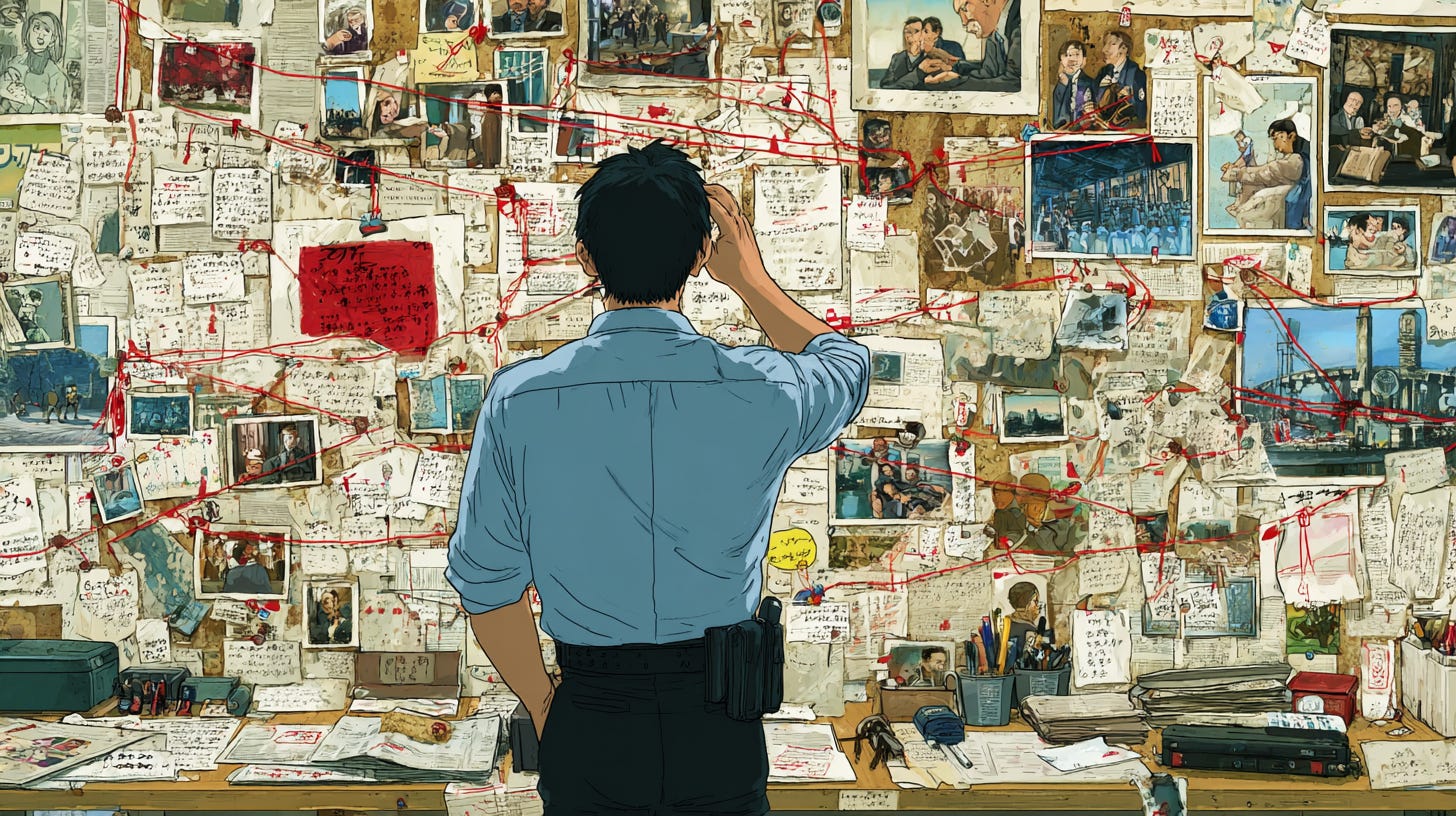
I want to talk to you for a second about murder boards.
You’ve seen them a hundred times before. Every time you’ve watched a TV show with an elite squad of homicide detectives hunting a serial killer, there’s a big corkboard somewhere in a basement conference room. Scattered over the surface of this bulletin board is an array of photos, newspaper clippings, bits of evidence, and other assorted scraps of paper.
Between those scraps, a network of pushpins and red string ties the whole thing together, connecting the victim with the scene of the crime, the murder weapon with the getaway vehicle, and the culprit with the motive.
That’s called a “murder board.”
The writers working on those TV shows (and all TV shows, actually), use pretty much the same kind of setup to plot and plan the story arc of each season. How do the characters relate to each other? How does the plot unfold? What are the secrets, and how do we gradually reveal them?
To me, the most interesting thing about these murder boards is that they have two essential components: the clippings, and the string.
And the clippings always come first.
If you’re an elite detective, working on cracking the next case and catching the next psychopath, how do you build your murder board? You can’t possibly stretch out the string first, and then attach the photos later!
You always start with the clippings, pinning each new clue onto the board, unsure of how it might (or might not!) ever relate to its neighboring clues. At this point, you don’t worry about excluding unimportant facts. You want to expand your area of inquiry as wide as possible.
Then, as more and more evidence accumulates, you begin to shift and rearrange things in a state of uncertainty for a while, squinting your eyes to see potential connections between the fragments in front of you. As those connections materialize, you test them to see if they withstand scrutiny (Was the suspect’s cherry-red corvette actually the same vehicle seen fleeing the scene of the crime?) and when they prove themselves reliable, you stretch a filament of thread between two pushpins to signify the connection. This new fact becomes part of an emerging scaffolding of knowledge that helps reveal new avenues of inquiry, in an iterative and self-reinforcing process of discovery.
This is the basic process that underlies all forms of creativity, a process which I call: Proliferate/Consolidate.
First you build a Collection, and then you make Connections.
And when you can’t find any more legitimate connections between the items in your collection, you can shift your focus away from “connecting” for a while, and go back into the “collecting” frame-of-mind.
Each mode of operating feeds the other, and keeps the process alive.
Every creative person instinctively works this way.
An artist scribbles and sketches before they draw. A writer outlines and writes before they edit and rewrite. An engineer tinkers and prototypes before they scale.
You start by being curious, by being a fan, by being an enthusiast… By taking an interest in what your peers are doing. If you’re a musician, you go to shows where your friends are performing. If you’re a playwright, you attend staged readings. If you’re a software engineer, you go to tech meetups or make open-source contributions. You meet people. You install new apps. You try things. You read reviews. You taste things. You travel. You go to gallery openings. You go to drag-races and block parties and get tattoos and bake pies and build furniture and brew beer and paint murals.
You have experiences.
In most cases, you won’t know how any of these new experiences will ever relate to your creative work. That doesn’t matter. You’re following your nose, and you don’t need to know how the clues connect yet.
You’re building a collection.
Right now, you’re in “proliferate” mode. You’re open, receptive, casting a wide net. You’re deliberately suspending your editorial instincts — that inner voice that wants to judge, rank, and prune — because judgment is the enemy of discovery. You’re building your collection, and a collection grows best when you let it sprawl.
At some point… you won’t know exactly when… But when you have enough items in your collection, you’ll begin to see threads of connection between those items. You’ll start to consolidate your observations into a set of principles, ideas, concepts, themes… After you proliferate, you always consolidate. Some of the avenues you thought might be fruitful start to dry up, so you abandon them. Other ideas start to show promise, so you follow those paths to see where they lead. Now you’re invoking your editorial instincts, testing which connections are worth keeping and which are worth abandoning.
That’s how you make connections.
But don’t bother pruning a budding connection during the “collection” phase, or going out on an exploratory tangent during “connection” phase. This is the deeper truth behind the sage and oft-repeated advice: don’t edit while you’re writing, and don’t write while you edit.
There’s a certain discipline to this process, and you can easily break the delicate balance by focusing too much on one side or the other, or by getting your priorities cross-wired.
As you go through successive rounds of collecting and connecting, proliferating and consolidating, you start to see that creativity is like breath.
Breath.
After every inhalation comes an exhalation.
Whenever you proliferate, you must consolidate.
From every collection emerges a set of connections.
And as this process repeats, it also recurses in upon itself, so it applies not just to an individual creative work, but over time across your body of work… Each sketch becomes a drawing, or each prototype becomes an app or a platform, or each recipe becomes a restaurant.
As you undergo this process, your own work becomes a body of work. You start to develop depth in a genre. You discover a unique narrative voice or flavor profile.
You create a unique world, where others can explore, and where they can make their own discoveries too. The creative process recurses both inward (within you as a creator) and outward (within the creative lives of those who you inspire).
That’s how individual creativity becomes communal. That’s how we build culture, and how we all engage in the process of collecting and connecting together.
This framework also illuminates something about the instruments of creative work — the pencils, typewriters, pianos, mixing bowls, compilers, and cameras that creators pick up every day. Each of these instruments is just as well-suited to playfulness as it is to rigor. A piano is a toy when you’re noodling through chord progressions at midnight, and a tool when you’re drilling a passage for performance. A mixing bowl is a toy when you’re improvising a new recipe, and a tool when you’re scaling it for a dinner party. The things we build for creators should support play just as much as they support production. When people have a chance to play, it lights up their mind with possibilities, and the things we build as toys quickly start to become essential tools. Creative work needs play.
The instruments that support “play” — the things we’d call “toys” — are supportive of the Proliferate part of the process. Toys help us casually expand our collections with unexpected possibilities.
When those same instruments help us consolidate — to build connections — we call them Tools. Tools are reliable, reusable methods for incorporating our vast possibilities into the workaday process of production and scaling.
The best creative instruments are things that can be used both as toys, during casual play, and as tools, for standardization and scaling. A sketchbook is a toy when you’re doodling at a café, and a tool when you’re refining a composition. A word processor is a toy when you’re freewriting at midnight, and a tool when you’re polishing a final draft. The instrument doesn’t change — your relationship to it does, shifting between proliferation and consolidation, between play and craft, between breathing in and breathing out.
This is the rhythm of all creative work. Learn to feel it, and you’ll never be stuck for long. When you’re lost, proliferate. When you’re overwhelmed, consolidate. And trust that the breath will carry you forward.